
Wisewand and Koala AI both turn a keyword into an SEO article, but they bill and work differently. Wisewand sells finished articles (one credit is one article) and includes an Autopilot that plans and publishes on a schedule. Koala AI sells a monthly word allowance, then adds Brand DNA, an SEO agent connected to Google Search Console and a dedicated Amazon affiliate workflow.
The short version: Wisewand suits regular publishers who want to budget in articles. Koala AI suits Amazon affiliate sites, brand-heavy content and anyone who wants a cheaper way in. Both still need a human to review every draft before it goes live.
Both tools have grown well beyond plain writing assistants, so a feature checklist won’t settle this. What does change the decision is how each one charges, what it automates and where it publishes. That’s what this comparison covers, with a cost-per-article estimate built from the published plans.
Disclosure: This article contains affiliate links. Solo Finds may earn a commission from qualifying purchases at no extra cost to you. The Wisewand links are affiliate links. The Wisewand section also draws on our own hands-on use of the tool.
Quick decision guide
Choose Wisewand if you publish SEO articles on a regular schedule, want to think in “articles per month” rather than words, and want Autopilot included from the cheapest plan.
Choose Koala AI if you write Amazon affiliate content, want the lowest entry price (plus a free allowance to try it), or want every article built around a saved description of your business through Brand DNA.
Skip both if you only publish a few articles a quarter. A general AI assistant plus your own editing will cost less and do most of the job.
Wisewand vs Koala AI: quick comparison
Most of what these two tools do overlaps, so the table below only lists the points where they actually differ.
| Point of difference | Wisewand | Koala AI |
|---|---|---|
| What you pay for | Credits: one credit is one article | A monthly word allowance, plus platform credits for other features |
| Entry plan | €67/month for 30 articles (excl. VAT) | $25/month for 45,000 words |
| Way to try it | A 3-day trial for €1 was offered when we checked | One-time free allowance of 5,000 words |
| Unused allowance | Credits roll over with no expiry date | Monthly plans: unused words and credits go into a rollover bank worth up to 3 months of your allowance. Annual plans don’t roll over. |
| Scheduled auto-publishing | Autopilot, included in every plan | Content Calendar Autopilot, from the Boost plan ($99/month) |
| Amazon affiliate content | Affiliate page, product review and comparison formats, not Amazon-specific | Dedicated Amazon workflow with live product data |
| AI assistant | Merlin: AI assistant that, per Wisewand, audits your site through Search Console, finds keyword opportunities and writes articles | SEO agent: reads Search Console and Analytics, plans keywords and briefs the writer |
| Publishes to | WordPress, Shopify, WooCommerce, PrestaShop, webhooks | WordPress, Shopify, Webflow, Ghost |
| MCP server | Yes, official | Yes, on every paid plan |
Based on each company’s own pages, last checked November 2, 2026.
What is Wisewand?
Wisewand is an AI platform for SEO articles. You pick a topic, it plans a structure from search results, writes the draft, adds images and can publish to your site. It also offers dedicated formats for affiliate pages, product reviews and product comparisons, alongside regular blog articles, e-commerce content and Google Discover content.
Every credit buys one article. Autopilot goes further: it reads your sitemap, builds a 30-day editorial calendar and publishes roughly one article a day. The daily limit is one article on Starter and up to 15 per project on Pro.
Our experience with Wisewand
I’ve used Wisewand for real content production, including affiliate-oriented articles. The biggest benefit was the time saved between choosing a topic and getting a usable, structured draft. The drafts still needed human editing: checking claims, tightening phrasing and adding real experience.
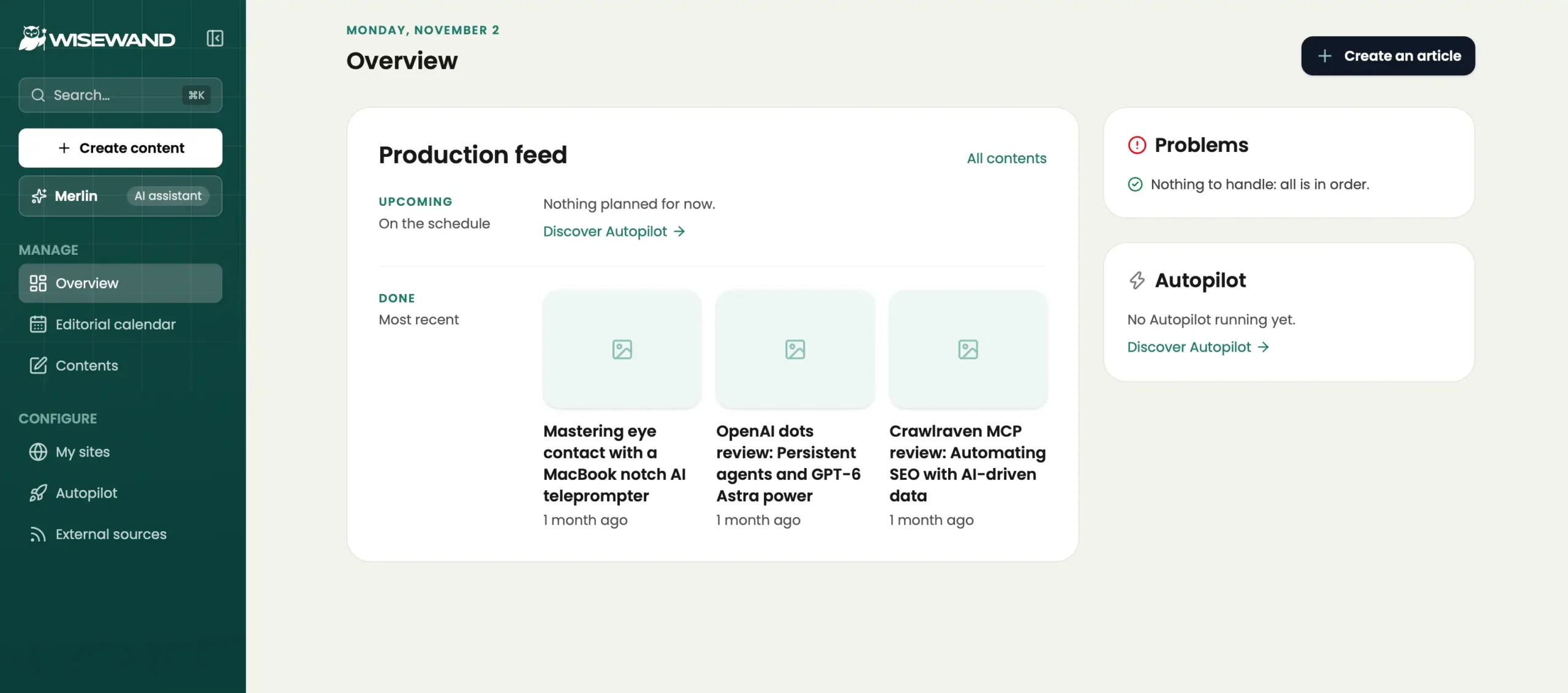
For the full breakdown of features, pricing and limits, read our complete Wisewand review.
What is Koala AI?
Koala AI is an AI writing platform that started with KoalaWriter, a generator for SEO articles and Amazon affiliate content. It now also covers images, internal links, a chat assistant and an SEO agent.
Two things set it apart. Brand DNA is a saved knowledge base about your business, so articles reflect your services, voice and facts instead of generic filler. The SEO agent connects to Google Search Console and Google Analytics, looks for keywords you’re close to ranking for, finds gaps where competitors rank and you don’t, spots pages competing with each other, then briefs KoalaWriter and publishes the result.
You can also choose which AI model writes each article. Stronger models use your word allowance faster (more on that in the pricing section).
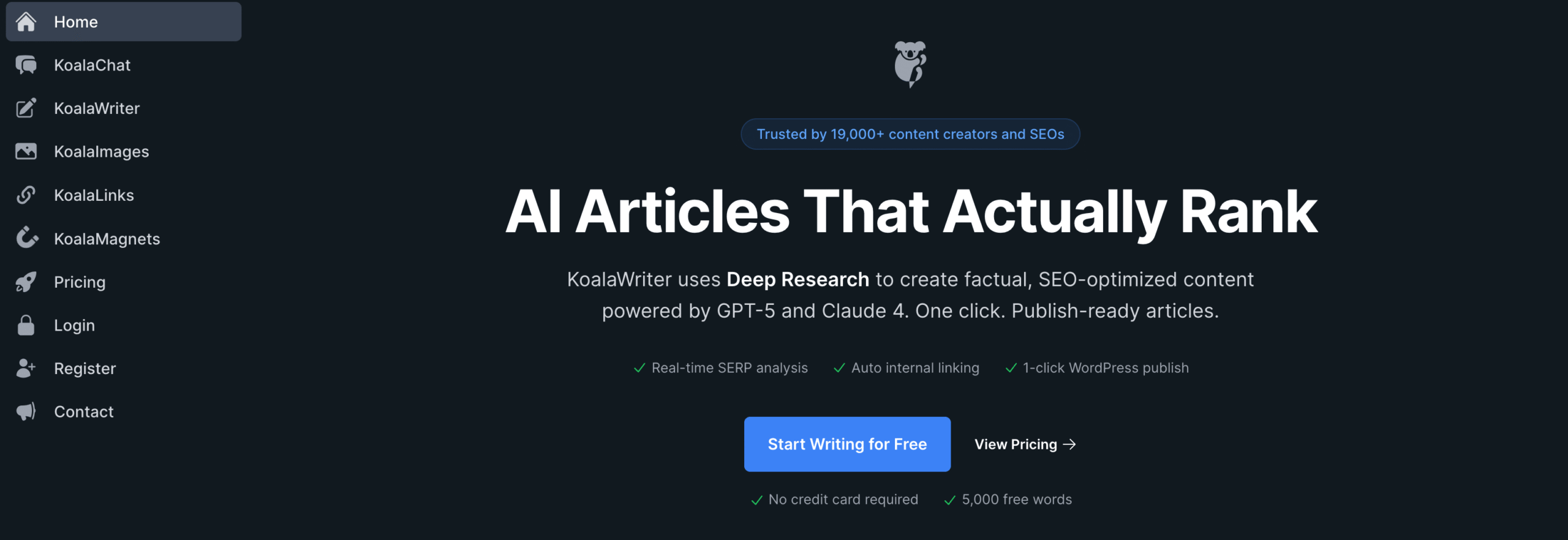
Our Koala AI review covers the features, plan limits and word multipliers in detail.
Research and article quality: which one writes better?
It’s tempting to judge an AI writer by the first article it produces. Neat headings and 2,000 fluent words look impressive, but they say nothing about accuracy, originality or whether the piece is actually useful.
Both tools start from search results rather than a blank page, and both let you steer the structure. Wisewand builds the plan from search-informed research, then writes. Koala combines SEO research with controls for structure and model choice, and can pull in Brand DNA and, on eligible plans, Deep Research.
Neither company publishes a quality benchmark, so any claim that one writes better than the other is hard to back up. What you can compare is the work left after the draft. Give both tools the same keyword and the same brief, then time how long it takes to fact-check, fix and finish each article. That number tells you more than any feature list.
Affiliate content: Wisewand vs Koala AI
Your content strategy should drive this choice more than any other factor.
For Amazon affiliate sites
Koala has a dedicated Amazon workflow that draws on live product data when writing reviews and roundups, which removes a good chunk of manual research. You still need to check prices and listings yourself, since they change and customer reviews aren’t the same as testing a product.
For software, SaaS and other non-Amazon products
Wisewand’s affiliate page, product review and comparison formats are built for this kind of article, and they’re the part of its workflow I found most useful for affiliate content. Koala can write these articles too through its general writing and research tools, so it isn’t an exclusive Wisewand feature. The difference is whether you prefer a format picked from a menu or a more open writing workflow.
What neither tool can do
Neither tool can supply first-hand experience. For a software review, your own screenshots, real use cases and honest limits are what make the article credible. Let the AI organize the material, and keep the experience yours.
Automation, bulk writing and publishing
Writing is only half of running a content site. You also need to decide what to publish, keep a calendar, add visuals, link related pages and get everything onto your site.
Wisewand Autopilot
Autopilot is included in every Wisewand plan, including Starter. It works from your sitemap, builds a 30-day editorial calendar and publishes to WordPress, Shopify or a webhook. If you’d rather not start each article by hand, this is Wisewand’s strongest argument.
Koala bulk writing and Content Calendar Autopilot
Koala’s bulk writing mode starts on the Starter plan. Content Calendar Autopilot, the scheduled publishing feature, only arrives with Boost ($99/month) and above. Without it, the SEO agent still plans your content, but you approve the plan before anything goes live.
Where each one publishes
This is a clearer difference than it looks. Wisewand connects to WordPress, Shopify, WooCommerce, PrestaShop and webhooks, and also offers a REST API plus n8n and Make options for custom workflows. Koala publishes to WordPress, Shopify, Webflow and Ghost. If you’re on Webflow or Ghost, Koala is the one that fits. If you run WooCommerce or PrestaShop, it’s Wisewand.
SEO assistants, GEO and MCP
Merlin vs the Koala SEO agent
Both tools now include an assistant you talk to. Wisewand presents Merlin as a personal SEO consultant: according to its announcement, it audits your site through Google Search Console, identifies keyword opportunities, writes and schedules articles and tracks your metrics. On its website, Merlin also prepares a first article from your site address. Koala’s SEO agent also works from your Search Console and Analytics data: it finds keywords you’re close to ranking for and competitor gaps, then briefs KoalaWriter and publishes. It’s available from the Professional plan, with 50 messages per cycle there and no message cap on Boost.
On paper the two overlap a lot, so the useful test is practical: connect your own Search Console data to each and see which suggestions you’d actually act on.
What about GEO and AI search?
GEO, or generative engine optimization, means making your content easy for tools like ChatGPT, Perplexity and Google AI Overviews to understand and quote. In practice that comes down to clear headings, direct answers, accurate facts and sources. Koala’s SEO agent includes an AI Search Focus mode aimed at those assistants. No tool can guarantee that an AI will cite your article, though. Software can help you write well-organized content; it can’t buy you citations.
MCP
MCP (Model Context Protocol) lets an AI assistant use outside tools. Wisewand has an official MCP server that works with Claude Code, Claude Desktop, Cursor, VS Code and Windsurf. Koala’s MCP server comes with every paid plan and works with assistants such as Claude and ChatGPT, using the same credits as the rest of the platform. For everyday article writing you don’t need MCP with either tool. It matters mostly if you already run your work from an AI assistant.
Wisewand vs Koala AI pricing: what do you actually pay for?
The two billing models don’t line up. Wisewand charges per article. Koala charges per word, and the number of words an article costs depends on the model you choose.
Wisewand plans
| Plan | Monthly price | Yearly price | Articles per month | Sites |
|---|---|---|---|---|
| Starter | €67 | €670 | 30 | 1 |
| Pro | €147 | €1,470 | 90 | Unlimited |
Prices exclude VAT. Yearly billing is listed as two months free.
Unused credits roll over with no expiry date, and every credit covers a full article, images included.
Koala AI plans
| Plan | Monthly price | Words per month | Platform credits |
|---|---|---|---|
| Starter | $25 | 45,000 | 500 |
| Professional | $49 | 100,000 | 1,000 |
| Boost | $99 | 250,000 | 2,500 |
Annual billing takes 20% off. A free allowance of 5,000 words is available to try the platform, and paid plans come with a 15-day refund window.
Rough cost per article
To compare the two, we assumed a 2,000-word article. On Koala, the basic model counts words at 1x, balanced models at 2x and the top-quality model at 3x, so the same article uses up to three times more of your allowance.
| Plan | Articles per month | Approx. cost per article |
|---|---|---|
| Wisewand Starter | 30 | about €2.23 |
| Wisewand Pro | 90 | about €1.63 |
| Koala Starter, basic model (1x) | about 22 | about $1.14 |
| Koala Starter, balanced model (2x) | about 11 | about $2.27 |
| Koala Starter, top-quality model (3x) | about 7 | about $3.57 |
| Koala Professional, basic model (1x) | about 50 | about $0.98 |
| Koala Professional, balanced model (2x) | about 25 | about $1.96 |
| Koala Professional, top-quality model (3x) | about 16 | about $3.06 |
A rough guide, not a quote. The two prices are in different currencies. Wisewand doesn’t state a word count per article on its plan page, and the Koala figures ignore platform credits spent on extras such as images or the SEO agent.
The takeaway: Koala is cheaper per article on its basic model and gets more expensive as you move to stronger ones, while Wisewand’s price per article stays fixed. If you always write on Koala’s top-quality model, the per-article figure climbs above Wisewand’s. If the basic model is good enough for your drafts, Koala costs less.
Which one should you choose?
Start from the work you actually do, not from the feature list.
Choose Wisewand if…
- You publish SEO articles regularly and want to budget in articles.
- You write software, SaaS or other non-Amazon affiliate reviews and comparisons.
- You want Autopilot included from the first plan.
- You publish on WordPress, Shopify, WooCommerce or PrestaShop.
- You want credits that roll over with no expiry date.
Choose Koala AI if…
- Amazon affiliate content is a big part of your site.
- You want the lowest entry price and a free allowance to test first.
- You want articles built around Brand DNA, your own business facts and voice.
- You want an SEO agent that works from your Search Console data.
- You publish on Webflow or Ghost.
If you only publish a few articles a month
A monthly subscription to either tool is hard to justify when you publish a handful of articles a quarter. Koala’s free allowance is a low-risk way to see whether the workflow suits you, and a general-purpose AI assistant may cover the rest. Wisewand is easier to justify once you publish consistently.
If you run an affiliate site
The products you cover decide it. For Amazon-heavy sites, Koala’s Amazon workflow deserves a serious look. For software, SaaS and digital products, Wisewand’s review and comparison formats are a good match. Either way, you still have to verify product details and make honest recommendations.
If you manage several sites
On Wisewand, the Starter plan covers one site and Pro covers unlimited sites, so multi-site publishers end up on Pro. Work out your real monthly volume first, because the plan that looks cheap at entry level may not fit your workload.
Final verdict: Wisewand vs Koala AI
Wisewand and Koala AI are closer competitors than they used to be. Both research from search results, both publish straight to your site and both offer some form of automation. The decision comes down to three questions.
How do you want to pay? Per article (Wisewand) or per word (Koala). If you like a fixed price per article, Wisewand is easier to plan around. If you’re happy to watch a word allowance and pick models carefully, Koala can be cheaper.
What do you publish? Amazon roundups point to Koala. Software and SaaS reviews and comparisons point to Wisewand’s dedicated formats.
How much do you want automated? Wisewand includes Autopilot from Starter. Koala keeps scheduled publishing for Boost and above, but gives you a deeper SEO agent and Brand DNA.
If you publish SEO articles on a regular schedule and want the simplest path from topic to published post, Wisewand is the more straightforward fit. If you work in Amazon affiliate content or want to start cheaply and build around your brand, Koala AI is the better match. Whichever you pick, review every draft before it goes live.
Ready to compare them yourself?
Check the current plans, run the same brief through both and see which draft takes less editing.
The Wisewand button contains an affiliate link. Solo Finds may earn a commission on qualifying purchases at no additional cost to you.
Wisewand vs Koala AI: frequently asked questions
What is the main difference between Wisewand and Koala AI?
Wisewand charges per finished article (one credit is one article) and includes Autopilot in every plan. Koala AI charges a monthly word allowance and adds Brand DNA, an SEO agent connected to Search Console and a dedicated Amazon affiliate workflow.
Is Wisewand better than Koala AI?
Neither is better for everyone. Wisewand fits regular publishers who want a fixed price per article and built-in scheduling. Koala AI fits Amazon affiliate sites, brand-focused content and anyone who wants a lower entry price.
Which is cheaper, Wisewand or Koala AI?
Koala AI has the lower entry price: $25 per month against €67 for Wisewand Starter. Per article, it depends on the model you use. On Koala’s basic model a 2,000-word article costs roughly $1.14 on Starter, while on the top-quality model it costs roughly $3.57. Wisewand Starter works out to about €2.23 per article.
Which tool is better for Amazon affiliate articles?
Koala AI, because it has a dedicated Amazon workflow that uses live product data. Wisewand offers affiliate page, product review and comparison formats, which suit software and other non-Amazon products.
Can both tools publish to WordPress?
Yes. Beyond WordPress, Wisewand also connects to Shopify, WooCommerce, PrestaShop and webhooks, while Koala AI publishes to Shopify, Webflow and Ghost.
Does Koala AI have an SEO assistant like Wisewand’s Merlin?
Yes. Koala’s SEO agent reads Google Search Console and Analytics data, finds keyword opportunities and competitor gaps, then briefs the writer. Wisewand describes Merlin as an assistant that audits your site through Search Console, finds keyword opportunities and writes and schedules articles.
Do Wisewand and Koala AI help with GEO?
Koala’s SEO agent has an AI Search Focus mode aimed at Google AI Overviews, ChatGPT and Perplexity. Neither tool can guarantee that an AI assistant will cite your content.
Which languages does Wisewand write in?
Wisewand writes articles in more than 100 languages, and you choose both the language and the target country when you create an article.
Is there a free plan or free trial?
Koala AI offers a one-time free allowance of 5,000 words. Wisewand has offered a 3-day trial for €1 rather than a free plan, and its Autopilot trial rolls into a paid plan automatically, so read the conditions before you start.
Do unused credits or words expire?
Wisewand credits roll over with no expiry date. On Koala’s monthly plans, unused words and credits go into a rollover bank that holds up to three months of your allowance, but annual plans don’t roll over.
Can both tools create and publish articles automatically?
Yes, with limits. Wisewand’s Autopilot is included in every plan and publishes about one article a day. Koala’s Content Calendar Autopilot starts at the Boost plan. Without it, Koala’s SEO agent still plans content, but you approve the plan first.
Do Wisewand and Koala AI support MCP?
Yes. Wisewand has an official MCP server, and Koala AI includes an MCP server on every paid plan. You don’t need MCP to write articles with either tool.
Do I need to edit articles from these tools?
Yes. Both save time on research and drafting, but facts, product details and sources still need checking, and neither tool replaces first-hand experience.
More in this category: browse all AI writing tool reviews or see our guide to the best AI writers for SEO.
Last checked: November 2, 2026. Prices and plan conditions may change.
This article contains affiliate links. We may earn a commission if you purchase through our links, at no extra cost to you. Our hands-on experience applies to Wisewand. Opinions are our own.